LEO and Military folks “know” guns…

No.  No, they don’t.  Not necessarily.  (I’m sure this post will make me some friends.)

There are an amazing number of people out there who fervently believe that just because an individual is former/current military or former/current law enforcement, that not only are they expert with firearms (both handguns and long guns, apparently), but A) they know good, solid citizen self-defense tactics and skills, and B) they can teach said tactics and skills.

You know what?  Not only are A and B not necessarily true (matter of fact, most of the time those are not true), but the basic premise of “expert with firearms” isn’t remotely true either.

This isn’t saying that no military and law enforcement folks are good shooters—there are a number of mil/leo people who are outstanding shooters of all types.  However, this is completely separate from saying that being mil/leo automatically means one is expert with firearms.

Are most military/leo better than the average gun owner?  Probably, up to a point.  That isn’t because military/leo firearms training is that fantastic, it is because the vast majority of gun owners aren’t shooters—they merely own guns, and play around with them every once in awhile. As such, it is a very low bar to get over, to say that anyone is better than the majority of gun owners.

This doesn’t make mil/leo folks expert.  Sure, Bob Vogel, Ted Puente, Shannon Smith, Frank Proctor, Pat Mac can all shoot at an incredibly high level.   And yet, if you grabbed your local law enforcement department and closest military company, and had them demonstrate their pistol skills (and their rifle skills), “expert” is not the conclusion you would reach.  (Heck, local departments sometimes have numerous members who have difficulty qualifying each year–and the NE LEO Firearms Qualification is amazingly easy.)

Matter of fact, “safe” is not necessarily the conclusion you would reach, either.  That isn’t a failure of the mil/leo individuals–it is a failure of the way they are trained.  When they don’t get to handle a firearm except when on the line, when they aren’t trusted with a loaded firearm except when given specific range commands, when they aren’t given the funds and facilities to actually practice—and most of all, when the instructors aren’t training them in safe gun handling (merely safe range practice, which is something very different), then of course they really don’t know safe firearms handling.

Military or Law Enforcement experience does not equate to shooting skills, and it certainly doesn’t mean that they know how to teach said skills.  They might be able to shoot better than the average gun owner—but if you are actually going to a class to learn how to shoot better, then you aren’t an average gun owner, and you certainly don’t want to be taught by one.  And when given a choice of firearms training, making your decision based on whether or not the instructor is current/former LEO or military really isn’t relevant, especially if your goal is learning shooting skills and citizen self-defense tactics.  (If your goal is learning military shooting techniques, that is a different story.)

Police officers have VERY different tactical priorities compared to normal citizens.  Military folks have VERY different rules of engagement compared to normal citizens.  And if you think that having an LEO/MIL background means they automatically know everything about guns—-you should get yourself to a shooting course taught by someone who really DOES know how to shoot.

I’ve shot with a number of police/military folks.  Of them, most are perhaps slightly better than your average gun owner if I’m feeling generous—but much worse than your average USPSA shooter.  Not all of them, of course—we have a couple of outstanding local shooters who are military or LEO.  BUT…..most military/LEO that I’ve seen who ARE good at it are only good because of the extra time and training they put into it themselves.

It certainly wasn’t due to their LEO/military training.  And that is completely separate from someone’s ability to actually TEACH the subject.

So sure, like most people I prefer to have an instructor that has experience in the situations that they are attempting to prepare me for—but that preference is a distant third compared to first being solidly competent in technique, and secondly being able to transfer that technique to me via teaching.  (And since most military and LEO folks don’t have experience in citizen self-defense situations and tactics, their experience, while related, really isn’t the same anyway.)


This post brought to you by recent experience with a couple of local instructors who are former military/LEO, one of whom demonstrates frightening levels of not-safe-ness in class, the other of which pontificates incorrectly about “what really happens” by “expert sourcing”* his “facts” (i.e. his opinions are actually facts, because he says so, even in the face of actual research data). 

They both charge about twice what I do for classes. [sigh]  And people take these classes, presumably because they don’t know any better. And continually talk about how they are great instructors because of all their military and law enforcement experience.


*Thanks to Ben Stoeger for the “expert sourcing” phrase.

Learning to shoot, part IIA….how to PRACTICE! (dry-fire section)

So, you’ve got the fundamentals down pretty well, you’ve got the basics of a safe, efficient draw and reload, you’ve practiced transitions, worked on your splits, done some practice with effective movement and a bit of shooting on the move…

…how do you get better without paying for more training?  In other words, how can you set up dry and live fire drills to give you the maximum improvement for your time?

Well, first you need to figure out what exactly you need to improve.  What are your goals?  Better competition shooting?  Better self-defense techniques?  What exactly are you trying to learn?  Creating a list of specific skills you wish to improve will help you organize your practice in an efficient fashion.

Here are a few skills that should be on everyone’s list, no matter how skilled they think they are–and these skills should STAY on your list, no matter how much better at them you get:

  1. Drawing to a close, high-percentage target
  2. Drawing to a distant, low-percentage target
  3. Emergency (slide-lock) reload
  4. Speed reload
  5. Transitions
  6. Trigger control:  freestyle, SHO, WHO

(These are NOT in order of importance, by the way.)  Now, obviously there are other skills that should be added, depending on what your goals are for practice.  However, no matter what your goals, you should be practicing the above skills.

So let’s talk about how to practice…

Brief discussion about practice theory, regarding the best way to ingrain habits:

  • Frequent short practices cause more effective retention than longer practices that occur less often.
  • Imperfect practice does not improve skill—and it may actually worsen the skill.
  • And yet, if you don’t push yourself, you will not get better nearly as quickly (and your “best” level will be lower than it should be).
  • Focusing consciously on the skill you are practicing will increase skill retention.
  • It is extremely difficult to consciously focus on a particular skill for very long.

For most effective results, a combination of dry fire and live fire practice should be done—in particular, dry fire practice on a continuing, regular schedule (multiple times per week) supplemented with live fire practice.

The goal of the dry fire practice is to ingrain proper technique, and push yourself.  The purpose of the live fire practice is to test your skill, monitor for dry fire practice errors or issues, and practice usage of those skills.  (Yes, you also want to push yourself in live fire—but pushing yourself too hard results in unsafe practice, and shooting yourself is not a good way to increase skill.)

Ben Stoeger has an interesting comment in his video Training to Win, discussing one of the shooters:

“He saw something in his technique that he needs to change.  So he needs to take that back home and dryfire and then he’ll be able to make that change.  You can’t really change anything out on the range. You only have time to fire maybe a couple hundred rounds, maybe you can only make it out once a week--all the repetition has to be done at home, he has to do the dryfire.”  [Emphasis added.]

And he’s got a point.  Unless you get to the range 3-4 times a week, AND have plenty of ammo, you simply aren’t going to get in that many reps of any particular skill drill.   Compared to what you can do with dryfire, live range work really should be for testing skills, and practicing skill chains.

At home in dryfire is where you ingrain those basic physical skills.  That’s where you do the reps to make your movements smooth, fast, and precise.  That’s where you work to make the changes, and do them enough times to make them automatic.

And only THEN do you go to the range to test what you’ve done.  For most people, your capacity to learn physical skills during dryfire is MUCH higher than your capacity to learn them during live fire.

So how can we optimize our learning in dryfire?  Well, first off—have the self-discipline to dryfire every day.  No, you don’t have to set aside an hour every day–even 5 minutes can count.  Try for three times a week of at least 30 minutes, and at least 5 minutes a day the rest of the week.

What do you do for that 5 minute practice?  Wall Drill. Freestyle, SHO, and WHO. (Strong-hand-only and weak-hand-only.) Don’t even need to have your holster or any other gear on, just need the gun, don’t even need to have a magazine in it. 10 reps freestyle, 10 SHO, 10 WHO. Then do it again (10/10/10) but this time, practice bringing up the gun from a low extended ready position. Then do it one last time (10/10/10) but this time, practice extending it out from a compressed center ready position. Whole thing gives you 30 reps of each shooting style, and 90 as-perfect-as-you-can-make-them trigger presses. Takes under 5 minutes.

And it’ll make a huge difference in your shooting, all by itself—BUT you have to concentrate on being perfect for the entire time. Don’t just do the reps to get them over with. Concentrate on what you are doing. Focus hard on that front sight. Watch what it does when the hammer/striker falls. Know what the sights did when the gun went click and afterward. 90 reps total.

Does this get boring?  Only if you let it.  You need to have the self-discipline not to slack off and blow off practice in the first place–but ALSO to make sure you pay attention and focus for that five minutes of reps.  If you are having trouble focusing, strap on a holster and do the wall drill by drawing from the holster, instead.  (Freestyle, SHO, and draw-transition-to-WHO.)   If you have time, periodically switch from holstered to extended low to compressed ready start positions.  Work that trigger press.

Okay, how about the rest of the time–those 30+ minutes of practice?

That depends on your goals, and how advanced you are at your skills.  (In particular, how efficient your movement already is, and how automatic your basic skills are.)  In general, there are roughly three levels of dryfire practice:  basic skills, chained skills, and multitasking.  And most people should NOT work much on chaining or multitasking until their basic skills are solid.

So let’s talk about how to practice a particular basic skill.  Basic practice progression:

  1. Practice it perfectly without time reference
  2. Practice it slightly slower than your normal best speed
  3. Practice it at your best speed
  4. Practice it slightly faster than your best speed
  5. Practice it perfectly without time reference

Let’s say a person’s normal “par time” on a draw from a holster to an A-zone hit at 7 yards is 1.5 seconds.  This means that about 85-90% of the time, that person gets the draw finished with a good sight picture and prepped trigger in 1.5 seconds from an audible start signal.  (The other 10-15% of the time, there is a fumbled grip or a lack of sight focus, or something similar.)  Basically, when the shooter is doing their job, they can complete the skill within the par time consistently.

So, in dryfire, this skill should be practiced something like:

  • 5 reps with a start signal but no par time
  • 10 reps timed at 0.2 above the par time
  • 10 reps timed at the par time
  • 5 reps timed 0.1 below the par time
  • 5 reps timed 0.2 below the par time
  • 5 reps with a start signal but no par time

You get a total of 40 reps, the first 5 and the last 5 of which should be perfect, 20 of which should be solidly correct, and 10 of which are pushing you to be faster.  In general, the above will take somewhere along the lines of 5-10 minutes.

After some practice, you are going to find that you are now hitting 85-90% of the drills at 0.2 below your par time.  So—time to reduce the par time.

So to do this, you need to keep yourself a log of par times for various drills.  Periodically, re-evaluate your par times and adjust them.  (Don’t adjust them each time you practice, unless your par time is too fast and it is making you sloppy.)  Unless something is ridiculously easy, don’t change a par more often than every 6-8 practices.

Now—when doing this, it is incredibly important that you are HONEST with yourself.  Did you really have the correct grip on the gun?  A proper trigger prep?  A clear, focused sight picture?  Just throwing the gun around won’t make you better.  (Matter of fact, unfocused dryfire practice will make you worse pretty quickly.  You’ll feel faster, but you won’t be able to hit anything, and your control will go downhill fast.)

So—pick three different skills and work on them.  That’ll give you about a 30-minute practice time.  Set your par times, log them, and make sure to track what you practice.  Keep a “comments” section in your logbook to add sudden insights, problems that crop up, or questions that you want to think about.  If you suddenly make a change that makes a world of difference, write it down!

Next time you practice, pick three skills—two of which you practiced last time.  (Practicing a skill once, then not getting back to it for another month doesn’t actually help much.)  Keep practicing, and rotate those skills.  Get in reps.  Remember, shorter practices that occur more often are better than long marathon practices that only occur once in awhile.

If you have 15 minutes, do a full drill on one skill, plus the Wall Drill.  Every day you don’t do any other practice, do the Wall Drill.

Now, there are plenty of other things you can do in dryfire practice, but this isn’t a book, so I’m not doing to type them all out.  For those interested in basic skills, Steve Anderson’s first dryfire book is a great way to start.  For those interested in chaining or multitasking, Ben Stoeger’s dryfire books are excellent also.

And after all that, go out to the range and check yourself in live fire.  (Discussion on that will be forthcoming in the next post.)

Other posts in this series:

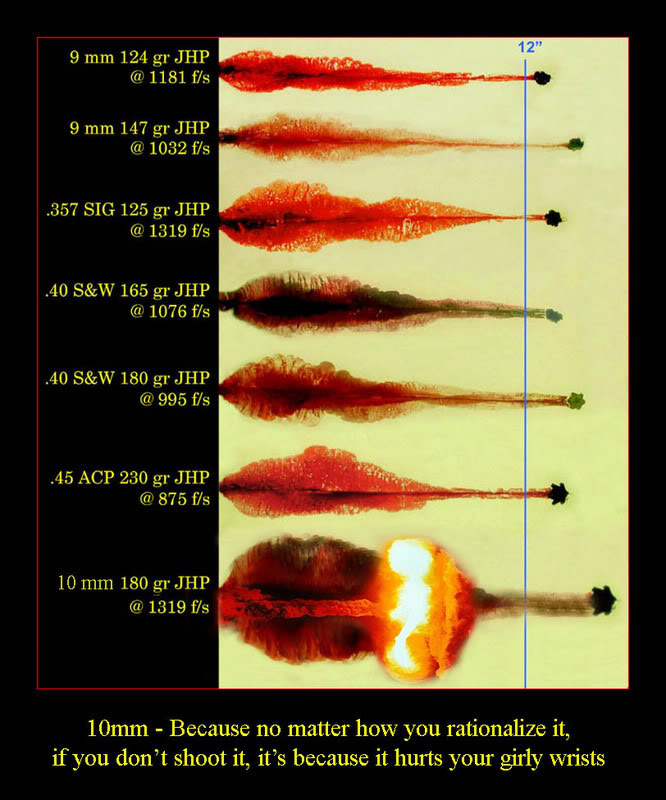
9mm vs .45 — which really IS better?

Yes, I’m diving into the “9mm vs .45” war.  No, I don’t care that you have a preference.  (I don’t care in that it doesn’t matter to me, though obviously it should matter to you.)  Yes, I realize that many people will immediately hate me no matter what I’m going to say next.

Before I jump in, though, here’s my question to you:  Do you know what current research says about ballistic effectiveness when comparing modern self-defense rounds between 9mm, .40S&W, and .45ACP?

If the answer is “No” then your opinion is useless, whether it happens to be right or wrong.  You see, here’s the deal:  Your ignorant opinion (ignorance:  lack of knowledge, which is not the same as stupidity) is simply not as valid as someone else’s knowledgeable opinion.  This doesn’t mean that you might not be right, and the other person can’t be wrong—but it DOES mean that if you start by saying “Well, I don’t know much about it, but I think…” —-then the rest of your sentence really should be— “….that I should shut up and learn about the subject before I express my opinion.”  If you happen to be right in your opinion, it is purely due to luck, since you have already admitted you don’t know what you are talking about.

Do you have a caliber preference in terms of self-defense round?  Probably.  Is that preference based on “feel,” personal expectations, personal experience, opinions heard on the internet, opinions heard from friends, or wide-scale research data?

Because while you are welcome to go with whatever your preference is, the only reason list above that is valid for reliable results is the last one—wide-scale research data.  How it “feels” doesn’t tell you anything.  Personal expectations based on what?   Personal experience—well, once you’ve shot 1000 people with varying rounds for comparison purposes, get back to me.  Opinions heard on the internet or from friends?  Please.  I’ve heard people advocating disassembling a handgun one-handed and putting the parts in a bag on the dashboard while coming to a stop on the highway when pulled over by the state patrol in order to make the LEO more comfortable with the firearm.

(No, I’m not kidding about that.  I wish I was.)

So why should you listen to my opinion?  Because I’m right?  How about because I’m telling you not to take my opinion as gospel, and instead telling you to look at what the research says, and what it means.

10mm-1


I realize that is actually considered sacrilege to the “.45acp is God’s Own Round” crowd and the “9mm capacity makes all the difference” crowd and the “.40 is the best of both worlds” crowd.  (Not to mention what the 10mm Manly Man are like on this topic.)  And yet—opinions based on lack of fact mean nothing.

Oh, good lord, I forgot the .357Sig fanatics.  Yeah, them too.


I’m bringing this up because I have a friend who carries a Glock 30 in .45acp all the time.   He likes to shoot IDPA matches, but realizes that particular gun is non-optimal for the IDPA game for all that IDPA touts itself as being for “real concealed carry” training.  In SSP or CDP he is at a “compact gun” disadvantage, and in SSP he is at a serious recoil disadvantage.

He asked me about switching to a 9mm for IDPA, and I asked him (since I knew he carried his G30) if he wanted IDPA to be for trigger time with his carry gun, or instead wanted to work on winning matches.  After all, while trigger time is always good, the grip on a full-size 9mm Glock is different from the grip on a G30, and if he wanted to work with both, it was going to take even more practice.  So, did he want to mazimize his SD practice and also play at IDPA, or did he want to practice with two guns, work on SD, and work on IDPA at the same time?  He decided that was really the question, and started thinking about it.

(I realize that at this time, the people who carry 5 different guns and rotate them out weekly or have the “you should be able to handle EVERY gun!” attitude will be wondering why this is a problem.  For you folks, never mind.)

Back to what my friend was thinking about:  When I thought about it, I really wondered if that really was the right question.  What if, instead, the real question is:  are you completely wedded to the idea of a .45acp for self-defense?

You know what current research says about modern self-defense rounds in 9mm, .40S&W, and .45ACP?  It says that 1) all are marginal in effectiveness, 2) reliable physiological stops only occur due to disruption of the central nervous system (CNS), 3) those calibers work equally well (or rather, equally badly) for shots placed in the CNS, and 4) all calibers (including .22) work equally well for psychological stops.  Oh:  5) Heavier bullets (in pistols) work slightly better to defeat intermediate barriers, if your lifestyle happens to be such that you often have to shoot through doors and windshields.

(How many .45/.40 folks just said, “Well yeah, see, mine is better” I wonder?)

How often DO you want to be able to shoot through intermediate barriers?  (Unless you have a job that potentially requires it, of course.)  Don’t people who think about normal citizen self-defense usually worry about the exact opposite?

So here’s the thing:  unless you have a job that requires you to have slightly better than pretty bad barrier penetration, there is no effective difference between 9mm, .40S&W, and .45ACP.  For physiological stops, they are all very bad unless you get a precise CNS hit, whereupon they all work equally well.  For psychological stops, they all work as equally well as a .22 LR out of a Beretta Bobcat.

So truthfully, my suggestion to my friend?  Think about carrying a G17 or a G19 instead of that G30, and use a G17 or a G34 in competition.  The grip, trigger, and recoil will all be similar, you’ll have more rounds for self-defense (without giving up much of anything in effectiveness), and you’ll be more competitive in IDPA all at the same time.

That isn’t to say that everyone should carry a 9mm.  You should carry whatever you like!  This merely is my solution to my friend’s problem, and YOU may not have this problem.  You may just like the feel of a 1911 in .45acp better plus you think JMB was the last True Prophet.  Or you may like the .40 because muzzle blast, recoil, AND capacity should all be maximized simultaneously.  Or maybe you like 9mm because…..well, there’s probably a reason out there somewhere to like 9mm.

Pick what you like.  But 1) don’t base your decision on some supposed “advantage” to one caliber in terms of effectiveness—there isn’t one, and 2) don’t let your personal preference get in the way of making the most logical choice for all the reasons you might need a gun.

And quit telling me that your caliber is better than the others for random nonsense reasons that have no basis in reality.


(No, I haven’t forgotten about the “How to Learn To Shoot” series—part IIA will be coming relatively soon.)

How do you learn to shoot? (Part I)

Note:  the following is for people interested in pistol shooting—specifically, people interested in self-defense pistol skills.  While elements of this will be true for rifle, shotgun or bullseye pistol also, that isn’t the focus of this writing.

How do you learn to shoot?

I know lots of people have a friend take them out and teach them a bit about guns.  Or learned from their parents or relatives, perhaps have gone hunting, tried a shotgun, a .22 rifle, or an airgun at some point in time.

But how do you actually learn how to shoot a pistol?  Meaning, what do you need to do to build solid safety habits, learn efficient, effective technique, and build significant competency?  Especially if you want to learn for self-defense purposes?  Or competition purposes?  For any actual purpose that involves more than plinking at aluminum cans at 15 feet with a group of friends?

I get asked this question (or variants of it) quite a lot, and so I thought I’d make a comprehensive reply for once.  In particular, a reply in which I can explain WHY you’d want to make certain specific learning events take place.  Because, quite frankly, most people don’t know how to shoot.  Yes, they CAN shoot—but they don’t really know how.  And then they “teach” other people to shoot (badly, and an in unsafe fashion) when they don’t know how unskilled or unsafe they are–and they tend to also have an inflated view of their own competency, which means that the people that they teach have an incorrect view of what “competency” actually means.  (For people who are thinking I’m too harsh, do a search on “first time shooting” or “new shooter” on YouTube, and watch how people are “taught” to shoot.  You’ll then end up thinking I’m not being nearly harsh enough!)

It is NOT hard to become competent with a pistol, from a self-defense or competition perspective.  (I’m going to focus on those two perspectives, as their goals are easy to describe.  If you have any other particular shooting goal, feel free to substitute it.)  However, the path to competency requires that 1) you realize what you don’t know, and 2) you practice.

Most people aren’t exposed to good shooting skills, so #1 doesn’t happen, and movies, media, and popular culture have misled people to believe that #2 isn’t necessary, that shooting is something you can just pick up and be good at immediately, unlike ANY other physical skill you’ve ever tried to learn.

And the path to competency requires also 3) learning efficient, effective technique for skill-building as opposed to making a habit of poor technique.

So how to you learn to shoot?

In the first part of this particular series of posts (this one) I’ll be talking about how you get started—what do you need to get a solid grounding in safety and fundamental technique so that later learning (in the correct mode, without having to break old bad habits) can occur–in other words, how you start on #3.  After that, in the second part, I’ll talk about how you can manage practice even if you don’t have time to get to the range–and how to practice if you can live fire.  The third installment will be about how #1 can always help you get better–and how not paying attention to it will cause your skills to (at best) stagnate, if not actually decline over time.

So yes, I’m taking those three points in reverse order.

I note that you don’t HAVE to do it this way.  I taught myself to shoot a pistol, and it worked out.  That being said, I know for certain that if I had done it the way I’m about to describe, it would have taken me a LOT less time to reach my current level, and I’d have had many less headaches and restarts throughout.

So, how to start:

First?  Take an introduction to handguns class from an NRA instructor.  Yes, there are other possibilities, other instructors, or your friends really MIGHT know what they are talking about when they try to teach you.  And yet—they probably don’t.  And if you don’t already have experience at shooting, you won’t know if a non-NRA instructor is any good or not.

This isn’t to say that the NRA Basic Pistol class is the best, most amazing thing in the world—it isn’t.  However, it IS a comprehensive, informative course that gives you a solid background in firearms, teaches good safety techniques, and the NRA method tends to mean that no matter what class you take (from whatever instructor you have), you’ll still be exposed to all of the information you need, plus get practice in good safety habits.

That being said, it is true that when I teach the NRA Basic Pistol class I add more practice time with inert practice firearms, plus more time with actual firearms.  In addition, I teach the “NRA Way” with respect to shooting technique—and then I teach how it has changed over time and what is currently considered the more effective, efficient way to shoot.  And I hammer on safety practice throughout.

And yet–the basic class (without any extras) is still probably the best place to start for just about anyone who has no shooting experience.  (And even for those people who already “know how to shoot” because their friend taught them in the backyard one weekend.)

Learn how to be safe every time you pick up a firearm.  Ingrain habits such that safety procedures are normal, everyday things, not things you do just when you “think it might be loaded.”  Don’t let yourself treat the firearm differently if you “know it isn’t loaded.”

Once you’ve got that, plus a solid grasp on shooting nomenclature and history, plus some basic practice at standard marksmanship (all of which you get from the NRA Basic Pistol class) next thing is to get yourself a full-size .22 pistol like a Ruger 22/45.  (And keep it—you’ll enjoy having it for the rest of your shooting career/life.)

Practice with the .22 pistol until you can comfortably shoot accurately.  (You’ll do more later, but for right now, learn and ingrain the fundamentals of safe handgun shooting so that you can hit the target consistently.)  A decent goal for this part, at this level, is to be able to consistently hit a 3″ circle at 10 yards.  This practice might only take you a month, if you go every day.  (Unlikely, yes?)  It may take a number of months of practice if you can only go once every two weeks.  How long it takes is up to you.  But no matter what, ALWAYS practice safe gun handling.

Next:  Buy a common, reliable, full-size pistol in 9mm with a decent trigger.  Pick a Glock 17, a S&W M&P, even a Springfield XD.  Full size.  No compact, no subcompact.  No LC9,  LCP, snub-nose revolver, or anything like that.  Full size, common, basic 9mm.

Buy basic range ammo (Winchester White Box, PMC, or Remington bulk ammo), then go to the range and practice the exact same things you were doing with the .22:  safety and fundamentals of shooting to include proper stance, grip, sight picture, and trigger control.  Don’t worry about speed, draws, or reloads yet.  Work on the ability to put hits on target correctly.  The rest will come AFTER you’ve practiced hitting the target.

Get to the point where again, you can consistently get hits on a 3″ circle at 10 yards using proper fundamentals.  Then get it so that you can do it without taking 3 minutes per shot.

Next:  Buy a decent range holster and some magazine pouches.  (Example:  Buy one of the Blade-Tech Revolution Combo Packs—there was a REASON we had you buy a common 9mm full-size pistol, because there are tons of equipment and accessories for those common pistols.) Buy some extra magazines, too, enough so that you have five or six of them.  Then take a class like the PRT Handgun Technique class, that teaches you how to correctly and safely draw from the holster, reload, and shoot at speed.  Learn proper transition technique, work on your trigger control at a faster rate.  Learn how to dryfire these techniques, so you can practice on your own.  Join a local gun club that allows drawing from a holster on the range.  Don’t just “teach yourself how to draw” — actually learn how to do it CORRECTLY.  (Because there is a right way to do it, and many wrong ways to do it.)

Go practice.  Dryfire.  Then live fire.  Dryfire 3 times a week (more, if you like).  Don’t know how to dryfire?  Well, hopefully that mid-level class you just took showed you how to perform good dryfire practice.  Try to live fire at least once every two weeks.  (Even 50 rounds at the range can be a seriously good training time, if you know how to practice.)   Make sure that when you practice, you are continuing to ingrain proper safety.

Buy a shot timer.  Yes, it’ll cost you $100.  It’ll be worth it.  Sure, you can potentially use a free shot timer on your phone, but it just doesn’t work very well.    Use decreasing par times in your dryfire and live fire practice to push yourself.  Don’t ever sacrifice safe technique for speed.

Once you have solid technique in drawing from the holster, reloading, and shooting, try a Steel Challenge match.  All you do is stand there, draw, and shoot with accuracy at speed.  It’ll test your abilities under a little bit of stress, and give you a realistic appreciation of your skill level.  And probably give you a reason to practice more.  Plus, it is just FUN.

After that—well, it depends on HOW good you want to get with a firearm.  And what breadth of skilll you wish to have.  There are of course additional shooting skills classes you can take, along with concealed carry and defensive tactics classes (from all sorts of people).  You can try USPSA action pistol shooting, IDPA competitions, or Multigun.  (If you are in the Omaha area at all, the Eastern Nebraska Gun Club runs USPSA, Steel Challenge, and Multigun matches.  Check out the Eastern Nebraska Practical Shooters site for details.)

No matter what—practice.  Dryfire.  And periodically practice using live fire.  Like every other physical skill, shooting well is perishable.

AFTER all that—then, (since you now have an idea of how to shoot, how YOU shoot, and what you like to shoot) —THEN go ahead and start thinking about what gun you should get for concealed carry, if you plan on doing so.  By now, you should have some solid experience with shooting, and you know your capabilities–which means you should be able to make good choices regarding a CCW firearm.

Short form:

  1. NRA Basic Pistol Class
  2. .22 pistol — go practice until competent at target shooting
  3. 9mm pistol — go practice until competent at target shooting
  4. Get good instruction on correct technique for draws, reloads, transitions, and movement
  5. Practice more, then push yourself with some competition.
  6. Keep practicing.

Then practice some more.  Continue to get good instruction on further shooting topics of interest to you.

In part II of this series, I’ll talk about HOW to get in good practice, both in dryfire and live fire.  (No, going to the range and just blasting out 100 rounds at a full-size silhouette target at 7 yards is not effective practice.)  Later, in part III, I’ll discuss how to make sure you never stop learning, and never get complacent about how much you know.

Thoughts?  Anything missing from this progression of training?

Other posts in this series:

Why do people keep saying IDPA is more accuracy-oriented than USPSA?

“IDPA rewards marksmanship, USPSA rewards speed.”

I keep hearing that IDPA is much more accuracy-oriented than USPSA…and I wonder why.

Most places that discuss the differences between IDPA and USPSA all seem to agree that IDPA is much more accuracy oriented, and that in USPSA it is all about speed.  (Or at least, significantly more about speed than IDPA.)  So much so, that in USPSA you can “miss fast enough to win” but in IDPA, poor accuracy will just destroy you.  Looking at articles, forum discussion, etc—everyone seems to agree with this.

And you know what?  I really don’t understand that.

Let’s take the last IDPA match I just shot.  I had some accuracy problems, and on a 12-round stage, shot one mike and one -1 hit.  (Roughly the equivalent of one mike and one C-hit in USPSA.)  In IDPA, this means 6 points down, for an additional 3 seconds of time added to my score.  I shot the stage in 16.25, so my total time was 19.25.

Here’s the thing:  Had this been a USPSA match, my initial hit factor would have been 43 points / 16.25 seconds or 2.6462.  (Misses really hurt your points in USPSA.  And for the record, I’m using Production Minor scoring here, which is what I shoot, which matches the gun/division I shoot in IDPA.)

Now, what if I had shot that stage perfectly in the time given by the final IDPA score, which includes their penalties for bad hits?  In other words, shot perfectly (60 points) but in 19.25 seconds?  (So, I’m using the time created by IDPA as the appropriate penalty for poor accuracy.)

My hit factor would have been 3.1169.  In other words, going slower but with better accuracy was worth MORE in USPSA, compared to what IDPA considered a reasonable penalty.

If USPSA and IDPA were equally accuracy/speed oriented, the hit factor should have stayed the same.  After all, that IDPA time corresponded to what they believe should be the penalty for poor shooting—that every C-hit-equivalent is worth half of a second, and every miss is worth 2.5 seconds of penalty time.

And yet, in USPSA, those points lost (for this case) are worth MUCH more than that time penalty.  One miss and one C-hit in USPSA means 17 points lost—which on a 60-point stage, is HUGE.

For this case, accuracy is MUCH more important in USPSA.

Okay, maybe that case is just an odd one–maybe most of the time, it is the other way around.

…and yet, it doesn’t really seem to be.  I’ve shot four stages in IDPA in the past two months, and in each case, the time penalty given for IDPA is worth significantly less than the penalty that occurs in USPSA due to poor accuracy.  (Particularly if there are misses involved.)

Here’s another way of looking at it:

If you take our scores from the last IDPA Nebraska match (which you can get from Practiscore) you can then look at how people did relative to each other.  If we do the normal % method, we can see that the difference between first place and second place using IDPA scoring was a little over 14%.  And yet, if we performed scoring using the USPSA method, the difference was only 7%.  The first place person ran the stages much faster than everyone else—but also dropped more points than most.

You’d think that the sport that was more accuracy-oriented would then have the smallest difference between 1st and 2nd place because 1st was faster–but dropped more points than the rest.  And yet, we see that it was in USPSA scoring where that lack of accuracy actually brought the 2nd-place finisher closer to winning.

What if there aren’t misses?  Well, if you get down to only one or two points down, AND the stage itself has close to the IDPA maximum of rounds, then you might get a case where the IDPA penalty is worth more than the USPSA penalty.

But the rest of the time?  A comparison of IDPA time penalties for points down (and what it does to your score) and USPSA points lost (and what it does to your hit factor) seems to show that dropping points in USPSA hurts you more than it does in IDPA.

…if you are shooting Minor in USPSA.  Shooting Major may be different.

An example that someone used on the Brian Enos forums awhile back, to “prove” how IDPA penalizes poor accuracy more, started with a standard “El Presidente,” and immediately showed how IDPA penalized poor accuracy far more than USPSA—and the math did work out.  However, for it to actually make a difference, the stage had to be only a few seconds long.  If you run the numbers, during extremely low-time stages, of course the IDPA penalties are going to be relatively bigger—as they are absolute, and don’t change.  However, once you start getting into stages that are 14 seconds or longer—something as small as one C-hit actually makes more of a difference in USPSA than it does in IDPA.  (I could show you the match, but I’m not sure you’d all be interested in it…)

It is also true that misses and hits on no-shoot targets get penalized a LOT more in USPSA than they do in IDPA, which is odd considering the “we do REALISTIC shooting” attitude of IDPA.  On a 12-round stage, if you pull a miss in USPSA, you have just lost 25% of your possible points on that stage, period.  In IDPA, you just added 2.5 seconds.    If it is a 5 second stage, that is one thing.  But if (like the stage last weekend) it was (at fastest) a 16 second IDPA stage, then it only made a 15% difference.  And since all those times add up, a faster run elsewhere can mitigate that problem.  In USPSA, you are never getting those points back.

This isn’t a “one is better than the other” sort of article, by the way.  It is merely a commentary that in both USPSA and IDPA, the people who win are the ones that shoot the most accurately, the fastest.  In neither one can you win by only being really accurate, or only being really fast.

For very short stages, yes, USPSA puts a higher premium on speed than IDPA.  For longer stages, the IDPA penalties for poor accuracy really aren’t as severe as what happens in USPSA.  (Again, this is based on USPSA Minor scoring, as guns fitting Production division are what is shot most in IDPA in this area.)

So please quit telling me that “IDPA rewards marksmanship, USPSA rewards speed” — because you know what?  To succeed at either one takes BOTH.

I need a gun to feel like a man?

Awhile back, people locally made a number of comments on a local mall’s Facebook page about the mall’s proposed policy to make itself a “gun-free zone.”  The comments were fairly standard, saying that if the mall didn’t want to allow them effective self-defense, that they wouldn’t shop there.  Almost all of the comments stayed civil and factual from the pro-self-defense side.  (Not quite all—there are always idiots on every side.  But almost all.)

Whereupon a number of people commented back with things like:

  • “I’m not paranoid enough to need to pack a gun when shopping.”
  • “I’m glad that people who think they need guns will stay away.”
  • “Why are you so scared?  Why do you need a gun just to go out in public?”
  • And my favorite:  “I’m glad the freaks who need a gun to feel like a man will stay away.”

….and the comments went downhill from there.

I really don’t understand why people who say those things happen to think that way. After all, surely they have a reason to believe that.  If they didn’t have a reason, they wouldn’t just make up vicious derogatory commentary, would they?  Perhaps they had some information that I simply don’t have.

Recently, I had a friend (we’d been friends for a number of years) post a very anti-gun screed, to which I replied with a large set of statistics (and links for all of the citations where I got my facts, such as the CDC and the FBI)—and the entirety of her response was:  “Scared Thomas? Take your precious guns and move to El Salvador.”

Um, what?  I said:  “Scared?  Hm.  So, your response to a set of statistics refuting your commentary was a personal attack?  Why?”

Her response?  “Are you scared of [sic] someone is going to take your precious firearms away or that I have an opinion?  We get it already Thomas, you love your guns, maybe more than life itself.  Compensate much?”

What?   This was the response to a set of logical arguments backed with statistics on a particular topic?

Is it that scary to actually look at the facts?  It is so frightening that people might need to re-think their beliefs in the face of actual data describing reality?  So upsetting that moving immediately to personal attacks seems to be a good response?

Paranoid?  Compensating?  Scared?  Need a gun to feel like a man?

Why would people jump to those conclusions?  I mean, I know that for many people, cognitive dissonance results in serious emotional reactions—but immediately jumping to ridiculous conclusions that make no sense, giving emotional motives to other people that have no basis in reality?  Seriously?  I mean, I’ve read this article:  Raging Against Self-Defense, but you’d assume that most people would at least START a discussion before immediately reacting emotionally.

You see, when I carry, I like to think it is because I’m prudent, intelligent, and and have taken responsibility for the safety of myself and the people I love.

I wear a seatbelt whenever I’m in a motor vehicle, even though I haven’t been in even a minor fender-bender in years.  I have a fire extinguisher in my home, even though it has never been on fire.  (Well, the outside was once when my neighbor set his lawn on fire, but I was elsewhere at the time.)  I keep jumper cables and a spare tire in my car, though I haven’t needed them in years.    I wear safety glasses when using a power saw, even though nothing has ever contacted the glasses.  When cleaning up my student’s chemistry experiments, I wear protective gloves even though none of the materials they are using are likely to be remotely dangerous.

In a similar fashion, I carry a concealed firearm because 1) I have looked into the prevalence of crime in my area and the probability of my lifestyle intersecting with someone else’s criminal action–and it is low, but not zero, 2) I am aware that no one else is able to protect both myself and my loved ones in a self-defense situation (most likely, no one else would even try), and 3) taking steps for protective purposes (like having a fire extinguisher, wearing safety glasses, and wearing seltbelts) is not difficult—you just make it a part of your lifestyle.

I’m not paranoid—it is unlikely that I’ll ever have to use any weapon at all.  (And that is a good thing.)  I don’t think I’ll “need” a gun—if I thought I was going someplace where I’d need a gun, I’d simply not go–but if I had to go, I’d bring 30 friends with guns, preferably all armed with cannon.  In a similar fashion, I’m not scared to go out without a gun—but like wearing a seatbelt, since it is simple and potentially useful, why not do it?

As for the “feel like a man” comment—it doesn’t really deserve a response (particularly since a number of CCW permit holders I know are female) but I will say:  “Projecting much?”

I realize it derails the whole “trying to be calm and rational in discussion” thing I’m trying for here, but seriously:  I’m tired of attempting to explain my perfectly rational behavior to idiots who prefer to make commentary based on the ignorant emotional projections of people who can’t be bothered to learn anything remotely resembling facts, or use any form of basic logic.

Want to discuss firearms and violence?  Excellent.  I’d be happy to engage in a discussion in which we debate so that we end up closer to the truth in our understanding of the world.  Please read and follow these rules for having a rational discussion, and we’ll have a great time.


Edited to add:

Read this link:  But YOU SAID THIS!!! Or why arguing with crazy people is pointless.

The entire thing is good—-but the last paragraph is completely brilliant.  And quite frankly, leaving out the hyperbole due to frustration, is pretty much spot-on.  (Thanks to Kozball for the link!)

“What would you do if…”

How often have you seen the phrase “What would you do if…” in a defensive tactics forum, shooting forum, or martial arts forum?  I’m pretty sure your answer is “pretty often.”

How many times have you seen people immediately give specific, detailed answers about how they would competently handle the threat/attacker/situation?

Unfortunately, I bet the answer to that is also “pretty often.”

Why is that unfortunate?  Because most of those “what if” questions give few details, and as such, there is no way to give a definitive, solid answer.  Which means that all of the people who did so either 1) added lots and lots of details in their own minds to an open-ended question so that they could give an answer where they could use their skills (making me wonder how realistic they are in terms of their own skills) or 2) don’t know what they are talking about in terms of actual self-defense.

Or most likely both 1 and 2.

Self-defense, as a concept, is very straightforward.  Self-defense, as a set of principles, is very simple.  Self-defense, as a set of techniques, is very basic.

Self-defense, as a set of choices in an unknown situation, is extremely variable.  Yes, there are a few situations in which your reactions should be cut-and-dried.  (Example:  someone tries to force you into a car to take you someplace different.  This is a “fight immediately” trigger.)  However, most situations are highly dependent on a large number of variables.

Some basic modifiers (and in this case, confounders) with regard to decision-making:

1) are you alone, or is there someone else with you, like a spouse or a dependent?
2) what routes of egress are there in the given situation?
3) what level of threat is being presented?
4) is the threat presented directly, or indirectly (to a group including you, as opposed to specifically at you)?
5) what level of force is being presented?  (not only for legal use of force responses, but also for decisions on reaction type based on threat level)
6) what physical condition are you in?
7) what encumbrances do you have?  (are your arms full?)
8) how immediate is the threat?
9) what defensive tools are available to you?  (not merely what are you carrying, but what are the surroundings like?)
10) what is the nature of the threat to you?  (junkie in withdrawal needing juice now versus a gang of teenagers out for a “lark” versus drunken ex-boyfriend—even if they all have the same weapons, that doesn’t mean your reaction is going to be the  same for each case, particularly due to the type of actions they will present.)

….this list could go on and on and on.

Which is why it is so important to have a solid understanding of the concept of self-defense.  And a clear set of self-defense principles.  And a good, practiced set of broad-based techniques.  Because if you have those, often the choices you will need to make will be clear.  However, if you aren’t “at that time,” the chances that a random question on a discussion forum will have enough details to make said choices obvious is—-small.

And if you think the answer to “What would you do if you are being mugged?” is “I’m going to explode off the X while acquiring my firearm and shooting them to the ground until the threat is stopped, then check my 360 after which I’ll tac-load to survive this dynamic critical incident”  —-then you REALLY need to go to to a class that teaches you about realistic self-defense.

Recently, MissMichella over on the NFOA forums (in this thread:  http://nebraskafirearms.org/forum/index.php/topic,10374.msg72925.html#msg72925 ) asked the following three questions:

1.  If you were in a business and someone was committing armed robbery, what would you do?
2.  If you were told to get in a stranger’s vehicle…and you could tell they had some evil intentions, what would you do?
3.  If you were mugged while armed, what would you do?

I was extremely glad to see that with the exception of question #2, most people’s answers were effectively “it depends.”  In the cases where people gave more specific answers, they almost always carefully added specifics of details that affected their decisions—but still left it mostly open-ended with a “it depends” tacked to the end.

As for me:  If I were in a business and someone was committing armed robbery, what would I do?

Depends.  Is it my business?  How many other people are in the store?  How many armed robbers are there?  Is there anyone with me?  Is the armed robber paying attention to only the cashier?  Is the armed robber actually pointing the weapon at anyone?  Have they already shot someone?  Have they threatened to kill anyone more than “give me the money?”    Can I simply slip out the back/side/front doors?  What are my egress points?  Is there any cover near?  Are the robbers paying any attention to me?  Who is in the line of fire?  Where will misses go (from either side)?  Is the cashier simply going to hand over the money, and the robbers are fairly calm and might just leave?  Am I being directly threatened?  Is my life in immediate danger?  If the cashier doesn’t pay, will my life move to being in immediate danger?  How am I armed?  What weapons are available?  How much attention are they paying specifically to me, and how much time would I have to access and use a weapon?  Can I just leave?  Move away from the situation?

Give me a specific situation, and I’ll answer the question—because discussing choices about these things IS important.  (And that’s why I think that scenario training is so important when learning self-defense.)

But only ask me a short question like the above, and I’ll need more details before I’ll be able to say anything.  And if YOU think you can answer the above question with a simple “I’ll just do THIS!” answer, you really need to take some different self-defense training.

Timers and Practice…

509-003

I’m a big fan of using a timer for shooting skills practice.  HUGE fan.  I believe strongly that if you don’t know where you are, then you don’t know where you need to go.

And yet, I almost completely agree with John Wallace in his blog posting about Randomness in practice:  Things to Consider Before Chasing the Timer (Part V: Randomness)   In it, he suggests doing a whole LOT of things that mean you can’t actually track your progress over time, and sometimes can’t even use a timer in the first place.

So how can I agree with both of those perspectives without demonstrating some significant schizophrenia?  (And we are going to leave my mental health out of this, thank you very much.)

Simple:  one of the above methods is for practicing shooting skills.  The other is for practicing applications of shooting skills.  There is a bit of grey area in there (for example, when practicing the skill of using cover, you still don’t try to beat the timer) but for the most part, the issue of randomness should occur when attempting to prepare for real-life self-defense (or military, or LEO) applications–not when learning the skills in the first place.

When do I use a timer?

  • Practicing my draws (hands at sides, surrender, concealment 2-handed, concealment 1-handed, WHO draw, sitting, prone, supine)
  • Practicing my reloads (emergency, speed, one-handed SHO, one-handed WHO)
  • Working transitions and splits
  • Practicing explosive movement into and out of positions onto near/far targets
  • …and many other specific physical skills.

Put it this way—specific skills, practiced in isolation, make you good at those skills, such that in terms of applications of said skills, you don’t have to think through the skill itself.  In application, you can then use the majority of your brain to concentrate on the situation, instead of having to devote part of it to remembering (for example) how to get a good draw using only your strong hand.

When you first learned how to work a manual transmission, you had to think about it a lot—at the expense of paying attention to your surroundings.  Someone ever try to talk to you when you were first trying to go from a stop into first gear uphill?  How’d that go?  Did you tell them to shut up until you got the car moving?  (I’ll bet you did.)

And yet, as you got more comfortable with the transmission, the amount of brainpower you had to spend on it became less—so that you could spend more time watching the road, and paying attention to the situation around you.  And talking with friends.

In a similar fashion, If your shooting skills are good, it’ll make your ability to apply those skills far greater.  You’ll have more brain capacity available for problem-solving, as less of it (less of the conscious part, at least) will be needed for the skill itself.

Using a timer for building skills means you have a way to measure your practice–what works, what doesn’t, what helps you improve most.  It gives you a standard against which to practice, a point at which you can say “okay, this skill is pretty good, time to change training priorities.”  (We don’t want to say “good enough,” unless it is “good enough that I should be practicing something else before I try to get this one better.)  For example, if your draw from concealment on a target at 7 yards is already 1 second, you might be better served by practicing other skills as opposed to trying to drop another 0.15 seconds.

But after your skills are solid (and while you continue to practice your skills), you should be practicing applications of those skills.  Say that you can already draw, reload, and shoot on the move.  Now, (with a training partner) set up a situation in which there are three targets in front of you, with varying (and mixed) colors, numbers, and shapes on them.  Have your partner yell out a combination that you have to recognize, and only shoot those targets.  Or maybe only NOT shoot those targets.

Too easy?  Have the targets appearing, (visual start, instead of an audible start) and also require that you shoot on the move to cover.

Still too easy?  Have your training partner give you a magazine that has an unknown number of rounds it in, forcing an emergency reload at some point in time.  Or instead, include a dummy round in the magazine somewhere to force remedial action under stress.

Those applications really aren’t made for timer work.  (You could use one occasionally if you want, but it won’t really tell you anything.)  The purpose of those applications is to train your brain to make appropriate situational choices—in which you need as much free brainpower as possible.  (As opposed to training your body to perform physical skills.)

If your skills practice was solid enough, then you should HAVE free brainpower available.  If, on the other hand, you haven’t put yourself on a timer for basic shooting skills, chances are that your skills are weaker than you think, and your shooting application success level will be far lower.

We use bullseye targets to measure accuracy, don’t we?  In a similar fashion, you should use a timer to measure speed.  (Unless, in your lifestyle, shooting is all bullseye and never self-defense.  No, there isn’t a timer in a self-defense situation.  There is another guy there who really is trying to be faster than you, however.)  And you should use a timer in your practice fairly often.

But you should also NOT use the timer fairly often, because in addition to training your body to handle specific skills, you need to train your brain to handle varying situations.

You are practicing two different things.  And unsurprisingly, the best methodology to use in these two different things, with two different goals—-is different.

What a shock.

Use a timer on known drills.  Also—incorporate randomness in your training.

(I will note my biggest disagreement with John is in his title.  He calls it:  “Things to Consider Before Chasing the Timer” —I think that Randomness and situational training actually should start occurring AFTER you’ve been chasing the timer for awhile.  Get good at specific skills.  Then, start practicing occasionally with randomness.)

First Time shooters—QUIT TEACHING THEM BADLY!

Before I start this, I should say:  If you are a shooter, please introduce other people to the fun of shooting.  Depending on the person, discuss self-defense, or hunting, or competition, or the crazy society of fun people who like to turn money into loud noises.  As people in the gun culture, the best way to help people understand us (and value the things that we value) is to take them to the range and make sure they have a safe and fun time.  An amazing number of people who are “against guns” really aren’t–they just don’t know anything, so their opinions are biased by what they see and read.  If you take them to the range and show them gun safety, plus they have fun—almost always, the gun culture gets a new convert.

Have you introduced someone new to shooting yet this year?  Not yet?  You might think of making that a goal—one new person every year.  If that seems too easy, try three new people per year.

It’ll make a difference, especially if we ALL do it.  That being said…

My last post (with the various range stories) also brought to mind one of my other perennial annoyances–namely, the number of people who attempt to “teach” other people how to shoot.  Badly.

“Teach” is in quotes for a reason.  I’m a teacher.  And when I say that, I don’t mean I happen to teach people (though I do), I mean that I’ve spent time learning about teaching modalities, about learning principles, about learning methods.  I’ve had education, training, and practice at effective teaching, effective communication, and encouraging learning engagement.  I’ve been getting paid for teaching SOMETHING since 1989.  I’m a science teacher, a martial arts teacher, and a firearms teacher.  I’m not just a trainer, I’m not simply an instructor, I’m a teacher.  (And whenever I’m in a class, I can’t help but critically examine the teaching ability of the instructor, separate from whether or not I’m getting anything good from his class.  I just can’t help it.)

So when I see some idiot who shoots incredibly badly themselves, who has no concept of firearms safety, and who has a completely inflated (and incorrect) view of their own skills and knowledge, “teach” someone completely new to shooting how to handle firearms, it drives me nuts–particularly when they set up the new shooter to be humiliated.

Which means I get driven nuts on a fairly continual basis.

Go to YouTube and do a search on “first time shooting a gun” and take a look at what people are being taught.  We get videos of people falling over, people screaming, people hurting themselves, pointing guns at other people—you name it, if it involves poor gun handling, you’ll see it.

Just a few examples, right off of that first page of search results:


— I love how at 0:38 he completely sweeps the camera person.  (Don’t tell me the gun was empty and locked back.  I don’t care.   And since he initially couldn’t even tell that it was locked back, it isn’t like we should trust him in the future to “only” flag people when the gun is “empty.”)  And he isn’t even the first-time shooter in the video!  (His grip is bad, too.)

Of course, then at 0:42 we find out that the first-time shooter was standing BEHIND HIM HOLDING A HANDGUN the entire time.  With a loaded magazine in it, apparently.  But I’m sure that someone will say “It was okay—there wasn’t one in the chamber!”

Hey look, she is holding a loaded gun with a teacup grip, no eye protection, and THEN he tells her how sights work.  Great idea!

After she jumps a lot, which is apparently really funny to someone, I love how “aim a little lower” means that she raises her head to look down the gun more.

None of this is her fault.  It is completely the fault of the people who are “teaching” her to shoot.  They did a great job of inflicting a completely horrendous flinch response into her shooting, that’s for certain.  “She’s flinchin’ less each shot!”  Yeah, right.  (Plus, you know, they are ignoring how her grip changes from bad to worse as time goes on.)

How about this one?


His comment in the description of the video:  “Like most she seemed pretty intimidated…”  —well then maybe you should have taught better, instead of just throwing a gun at her and saying “it’ll be all right!”

Or do people really think that starting by handing a loaded weapon to someone, and then telling about the controls, the sights, and how to pull the trigger is a good idea?

I also love how at 1:18, once he has the safety on, he puts his finger on the trigger as he is explaining the gun to her.  Even better, at 1:30 when she is getting ready to shoot, she holds it in an old-style revolver grip (thumb over strong hand) which will eventually give her serious slide-bite—and he doesn’t say a thing.

Even in the cases where the new shooter DOESN’T have a safety issue, they still aren’t being taught anything resembling decent technique.  Let’s take the first video that shows up in the search:


Starting with safety: no trigger finger discipline (it gets mentioned, but he isn’t doing it), no eye protection, no ear protection initially, guy in the background right on the 180 is oblivious to what is going on, kid given a loaded pistol before they have even been taught about sights, guy watching doesn’t seem to be wearing ear protection (and isn’t wearing eye protection)…

Technique-wise:  poor stance (looks like a combination of Weaver and rifle shooting, what with one elbow bent and the other stuck out sideways), poor grip (what is that? you can see he can’t hold onto the gun during recoil), trigger control isn’t too bad, but there is some jerking which is bad since he is shooting single-action already, so the trigger shouldn’t be that difficult–and he lowers the gun and looks at the target immediately after each shot.

None of that is the shooter’s fault.  And I’m glad that people are teaching him how to shoot, and how to handle firearms.  It would just be nice if people would teach them something RIGHT about how to handle firearms—both in terms of safety, and in terms of technique.

(That last one wasn’t nearly as bad as the others, I’ll note.  At least the kid didn’t feel like he was being made fun of, nor did he seem to feel scared of the gun.)

If you are going to introduce someone to the fun of shooting, please don’t start by making certain that they’ll be scared of guns for the rest of their lives, that they’ll feel humiliated, that they’ll feel like the whole thing was you playing a prank on them or making fun of them.  (For example, don’t do this: Woman gets hit in head with handgun. Yeah, that’s just hilarious.  Really.  That’ll teach her.)

Teach them gun safety.  Let them work with an unloaded gun, and get familiarized with the controls.  Start slowly and easily, to get them used to it.  Set up targets that are not “gimmes” that have no value, but neither should they be impossible ones—so that if they perform the fundamentals correctly, they’ll hit the target—and feel accomplished (as well they should) for doing it.

If you spend the time laughing at them, you will have made the gun culture an enemy.  Don’t do this.  If they are are laughing at how much fun they are having, and afterward they ask when they can come shoot again—you’ve done it right.

Do it right.

Because I’m curious—does ANYONE think that these sort of videos help our cause?

Collection of stupid people making girls look like idiots, and scaring them off guns forever

Yeah, that’ll convince more people to be on our side.  Well done.


If you are one of the people in the videos I referenced—I assume that you put them on the YouTube for the world to see. And the world being what it is, people are going to comment. If you feel like I’m criticizing you—well, I am. If you know guns, and you like guns, and you want other people to know and like guns, then please teach them correctly so that they don’t shoot themselves or each other, AND so that they can continue to get better and aren’t hamstrung by poor fundamentals.

I’m not saying you are a horrible person for not teaching correct gun safety.  I’m not saying you are a horrible person for teaching poor technique.  I AM saying, however, that you aren’t helping the person you are trying to “teach” if you show them poor technique and your practice lacks safety habits.  If you don’t agree—that’s up to you.  I can’t help what your opinion is, or whether it agrees with mine.

And, after all, I’m not the guy that demonstrates keeping his finger on the trigger when not shooting, nor am I the soon-to-be-deaf guy that shoots without hearing protection, nor am I the guy who swept everyone in the video.

My students don’t do those things either, by the way.  I wonder where they picked up those good habits?

Targets—size DOES matter…

This is not the post (referenced in the last entry) “in which I completely agree with [John] about how “chasing the timer” is a bad idea, and offer some suggestions for pistol shooters in terms of how to maximize their ability curve while using a timer.”

I’ll get to that one later.  In this case, I need to vent about something I saw at the range this past Sunday.  And have seen in the past…

John Wallace, in his series of posts on “Things to Consider Before Chasing the Timer,” started off by commenting about targets—specifically, that “If you train for these small presentations, or “worst case scenarios” then you are prepared for them, as well as getting sure hits on the idiots who stand in the open (giving you full presentations).

He also commented that a number of people practice on huge, open targets.

I was at the range the other day, and observed one male individual “teaching” a tiny woman  how to shoot a handgun.  He was there in his 5.11 pants and operator polo, full war belt (including multiple pouches and a huge drop bag) with a drop-leg holster.  (She was wearing shorts, a tank top, and flip-flops.)  I’m not sure what the gun was as I was quite a distance off, but it looked like a regular full-size handgun.  (I hope he wasn’t teaching her on a .45 or a .40, because I could see that this was probably the first time she had ever held a handgun.  Of course, he wasn’t actually fixing anything about her stance or grip, so maybe it wasn’t her first time and she’d been shooting with the leaning-back stance and teacup grip that he had taught her for quite some time.)

The target was a full-torso, full-size silhouette.  It literally was larger than the woman.  And it was placed all of 5 feet in front of her.


A year or so ago, I was on a bay practicing my transitions, and monitoring a couple of people who were with me working on their basic accuracy.  A couple of guys drove up, and started to unload their gear on our bay.  There was a discussion about that, and after the RO had a talk with them, they decided to wait until we were done.  (They did say the famous line “You are doing that competition stuff, we are practicing for COMBAT” which they thought excused the fact that one of them swept all of us as he walked up to our firing line swinging his handgun in one hand.)

As we were leaving, I saw them setting up a target approximately 10 feet in front of the shooting table (in a 50-yard bay).  It also was a full-torso, full-size silhouette target.  As I watched in fascination, they began shooting slow fire (resting the gun on the table between each shot) while sitting at the table.


My personal favorite, however, is the guy who brought his girlfriend (wife? not sure) out to “teach her how to shoot” (I will explain why I keep putting those all in quotes in a different post).  He took one of the range barrels, placed it 12-15 feet downrange, and commenced shooting at it to (and I quote) “show how it’s done.”  (No, he didn’t staple a target to it.  The barrel itself was the target.  At 15 feet, tops.)

I wish I could give you that quote in the self-satisfied tone in which he delivered it.

We then had a little talk about shooting the range equipment, and he decided to stop.


Why do people think that shooting at huge targets helps them at all?

When I teach someone completely new to shooting, I start with a standard-sized paper plate at 15 feet.  Using a .22, a newbie to shooting can quite easily get all shots on a paper plate if they are taught correctly.  After that, we move to 12″ steel plates at 10 yards—which they can ALSO do perfectly easily.  (And everyone loves hearing that “ding” of a hit.)

The target is big enough so that with a modicum of discipline, they’ll hit it every time.  At the same time, it is small enough that they actually have to use correct fundamentals to get those hits, plus they can work on shooting groups smaller than their target.  (I realize they can do that on any target, but if the target is huge and irregularly shaped, it makes it harder for new folks to actually center a group in the middle of the target.)

Why anyone would start a newbie on a huge target at such a close distance that hits are meaningless is beyond me.

And as for experienced shooters—WHY?!

Yes, I do occasionally practice on open targets at 5 yards—but that is when I’m timing transitions (and shifting gears) from near to far targets.  Or working on correct gears for draws to close targets versus far targets.  Or working on shooting on the move and finding the correct movement speeds at different target distances.

But when I’m practicing 1) the fundamentals of accuracy in a direct, singular fashion, or 2) self-defense related drills and scenarios, a wide-open target at close distance simply doesn’t make me any better.

Sure, it is interesting to see how fast you can get your draw-to-first-shot from concealment.  But once you can do a consistent 1.0 second draw on the upper half of the lower A-zone of an IPSC target at 7 yards, there are other drills that will be more useful to your self-defense ability than working on cutting that extra .15 from your draw in a very unrealistic scenario.

Sure, in real life often you really DO get an open target in citizen self-defense situations.  However—sometimes you don’t.  And even if you do, a peripheral hit most likely won’t stop the attacker.  Using minute-of-IPSC-target as your accuracy level simply isn’t good enough.  And if you are disciplined enough to practice in the first place, perhaps you should practice on targets chosen to increase your skills.

I’m not saying you should only practice shooting dimes at 10 yards.  (Though it is true that periodically, working accuracy on 1-inch dots at 3 yards, then 5 yards, then 7 yards, then 10 yards if you manage it, REALLY teaches you the importance of front sight focus and trigger control.  Or it gives you practice at dealing with a lot of frustration.  Or both.)  But instead of open targets, overlay a credit-card-sized box on the head as a brain box, a 2-inch column from the brain box down to the upper thoracic, a 4″ square centered at the height of the top of the heart, and force yourself to hit it every time.  Have one day be a “headshot-only” day.  Put targets far away.  Turn targets at an angle, and add a line of tape showing where the hardcover blocks any hits below a certain point.  Make the target something that requires you to shoot well to hit it.

If all you do is practice on the easiest target possible, well—-at least you are practicing.  But if you have the discipline to practice in the first place, use targets that actually help you get better.  Yes, you should periodically use targets of different sizes and shapes, some of which should be full-size.  And yes, you should periodically use target distances of different ranges, some of which should be nearby.

However—for the most part, you should practice on targets that match (or slightly exceed) your current skill level.  So quit using easy simple targets that don’t help you get better.  You are practicing to increase your skill, not merely make yourself feel good about your 0.85 draw and 0.14 splits on a 3-yard open target.